
Cardiff Miller Art Warehouse: Press the Button

Updated: Feb 2
Jessie Rivest visits The Cardiff Miller Art Warehouse in Enderby, BC, Jan 18. 2025

It was already anything but a typical weekend. I had family visiting from Montreal, and with it being the quietest time for activities in Kelowna, I was rigorously searching for things to do and restaurants to impress. Sunday had been allotted for visiting wineries, of course. But then it dawned on me… we have a car, she loves art, I have always wanted to visit the Cardiff Miller Art Warehouse. Maybe the stars had finally aligned. And oh, did they ever.
The three of us drove past highway billboards, weed dispensaries, and stretches of farmland. We pulled into a parking lot along the river, and the photos started snapping, capturing the excitement. Walking into the warehouse was like entering another world. Where were we? Quickly acclimatizing to a lobby seeping with nostalgia, retro vibes, and a story to tell, Kerrin, the Museum Manager, gave us the rundown of what to expect as we explored each exhibit.
Right behind the reception desk was Conversations with My Mother, rotary phones that we could pick up and listen to, literally the artist having conversations with her mother. I didn’t quite have the patience to listen on the phone for very long, and with others using the second handset beside us, I slipped out front and entered the larger part of the warehouse.

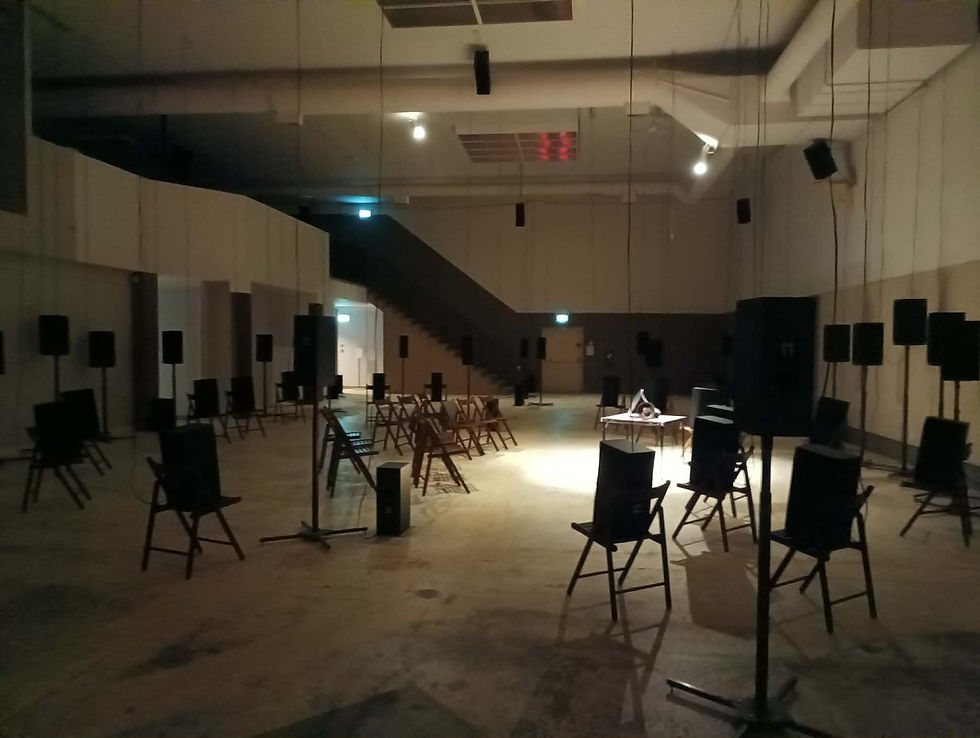
Being in such a large space was luxurious. The first half of the room was dedicated to a small camper with a floating umbrella and two gigantic gramophone-style speakers on top of it, but the sounds were coming from the other side of the room. Murder of Crows unfolded as a 30-minute “sound play” that felt like a film without images, using stereophonic recording to create a 3D sound field. Ninety-eight speakers played a soundscape that seamlessly shifted from cawing birds, to singer with guitar, to an epic men’s chorus with horns, drums, and more. Walking up to each speaker allowed the ears to focus on just one instrument at a time; one even held only a pizzicato string amidst the vast symphony. All of these parts seemed quiet and insignificant on their own, but as part of the greater whole, the effect was breathtaking.
When the music ended, our attention turned back to the camper van. Those two giant floating speakers had begun to spin like the inside of a music box. The Marionette Maker is full of small puppet-like creations, a clanking kitchen, and a human-sized wax sculpture that appeared to resemble the artist, lying in a nightgown in the back. Each pocket of the camper’s ecosystem had a sound and pre-programmed movement to match. When the bass guitar started, we found a tiny musician strumming in time with what we were hearing. There were starscapes to look into above, and a miniature scene of the camper out in nature below. We continued to circle the camper like art-hungry sharks, looking for the next marionette to take action. A tiny piano player and opera singer began to perform in front of three theatre seats that seemed to be meant for us.
Just my partner and I went into The Killing Machine. My other family member was too scared to press the button, afraid of what might happen. The animatronics began to move, surrounding an empty dentist chair. The sparse, dissonant string music created tension, and we began to worry for this invisible seated being who was being slowly. The scene was surrounded by static TV screens, which made me wonder if this could be a metaphor for how screen time is slowly killing an invisible part of us.
Another large room held two permanent installations. The Storm Room was exactly what it sounded like: stepping into a small space and experiencing a storm from the outside, complete with thunder crashes, lightning strikes, and drips from the ceiling. It was at once a little frightening, yet also beautiful and calming—if you enjoy storms. Again, we were struck by the fascinating interplay of high-tech and low-tech: objects that felt retro, with an 80s–90s aesthetic, made the programming and technological execution all the more impressive. Imagine if we had to return to analogue—who would even know where to begin?

In the middle of a massive circle of 40 speakers, there were benches to sit and a floor rug to lay, but the choir girl in me was inspired to walk around and listen to each voice as it beckoned into the echoey space. Voices of immaculate skill and precision sang Thomas Tallis’s Spem in alium (c. 1570). It was a simulated heaven. Complex and simple. Gratifying and peaceful. I watched my partner “conduct” the voices with his arms swinging freely. I smiled for so long it felt like I was posing for a photo.
The Cardiff Miller Art Warehouse has now become my top recommended “thing to do” in the Okanagan. You’ve already done the wineries, the beaches, the hikes—this is something entirely different. It’s rare to find a space that so boldly combines imagination, sound, movement, and community in one immersive experience. It doesn’t just showcase art—it reconfigures how you listen, move, and feel. Places like this are uncommon and revolutionary… and with everything going on in the world right now, don’t you think soaking some of that in sounds like a good way to spend a Sunday?
Jessie Rivest is a sound artist, leadership coach, and local arts supporter living in Kelowna.


Comments